Tuesday, 23 February 2016

Wednesday, 17 February 2016
Evaluation: Question 7 - Looking back at your preliminary task, what do you feel you have learnt in the progression from it to the full product? - Mrs. Quinlan
What was the preliminary task and what were its main aims?
The preliminary task was a task set to assess and evaluate our skills as a form of practical, hands on planning. It would later help with what improvements we had to make in preparing, filming and editing. We were given a limited amount of time to film a 30 second scene and it had to follow a certain criteria. We were also given a camera and the final cut pro x software we would eventually use for the final product. We discussed amongst our group and decided on group roles according to our skills. I was made as director/cameraman and editor. Trang and Pervin were actors, with Trang also being producer and location manager while Pervin had the role of costume, hair and makeup, although a lot of these roles were not needed during the preliminary task. As a group we would later take on different roles in the final production as their skills suited different roles. As editor I faced some problems when editing as I had never used Final Cut Pro X before, I could only develop very simple cuts and there was a problem as there was a filter we could not remove that was preset.
Product of the Preliminary Task
Identify 4 things you are now better at and more confident with doing in terms of filming and editing:
Filming
This is a panning shot I attempted to film for the preliminary task, the shot was very long and the camera was shaking a lot. This made it ineffective and had to be drastically improved to be able to apply it to our thriller.
This panning shot was the one used in the final cut of the opening. I had improved in terms of camera work to keep the camera as still as possible, as well as making sure not to keep the camera focused on a subject for too long which would bore the audience quickly. I made sure the camera was zoomed in and at an angle where you cannot see the antagonists face, only his movement and location in the house. There is also low key lighting which we made sure to have while the antagonist was maneuvering around the house which was very effective to create suspense for the audience. I was a lot more confident in this shot due to the effect it had on the audience.
In this clip from my preliminary task while filming a medium shot there is obvious camera movement at the end which was not professional and did not make the preliminary task look good. It involved a lot of camera shake and was ineffective, therefore my skill when filming had to be improved for the final production.
This clip was a drastic improvement from my preliminary task as I had made sure the camera didn't move and the positioning of the camera was a lot better. This made it a lot more effective for the thriller as the distancing was appropriate. The camera was also very stable as I was a lot more familiar with it and therefore the was no lurching while filming this scene.
Editing
The preliminary task was a task set to assess and evaluate our skills as a form of practical, hands on planning. It would later help with what improvements we had to make in preparing, filming and editing. We were given a limited amount of time to film a 30 second scene and it had to follow a certain criteria. We were also given a camera and the final cut pro x software we would eventually use for the final product. We discussed amongst our group and decided on group roles according to our skills. I was made as director/cameraman and editor. Trang and Pervin were actors, with Trang also being producer and location manager while Pervin had the role of costume, hair and makeup, although a lot of these roles were not needed during the preliminary task. As a group we would later take on different roles in the final production as their skills suited different roles. As editor I faced some problems when editing as I had never used Final Cut Pro X before, I could only develop very simple cuts and there was a problem as there was a filter we could not remove that was preset.
Product of the Preliminary Task
Identify 4 things you are now better at and more confident with doing in terms of filming and editing:
Filming
This is a panning shot I attempted to film for the preliminary task, the shot was very long and the camera was shaking a lot. This made it ineffective and had to be drastically improved to be able to apply it to our thriller.
This panning shot was the one used in the final cut of the opening. I had improved in terms of camera work to keep the camera as still as possible, as well as making sure not to keep the camera focused on a subject for too long which would bore the audience quickly. I made sure the camera was zoomed in and at an angle where you cannot see the antagonists face, only his movement and location in the house. There is also low key lighting which we made sure to have while the antagonist was maneuvering around the house which was very effective to create suspense for the audience. I was a lot more confident in this shot due to the effect it had on the audience.
In this clip from my preliminary task while filming a medium shot there is obvious camera movement at the end which was not professional and did not make the preliminary task look good. It involved a lot of camera shake and was ineffective, therefore my skill when filming had to be improved for the final production.
Editing

My editing skills have improved as I quickly learned to use the software Final Cut Pro X efficiently, a darkened theme was emphasised as I used a grayscale filter appropriately to convey a more gruesome, intimidating tone due to the antagonists presence. This effectively made the opening more frightening and increased suspense amongst the audience.
In this clip, while editing I had used slow motion editing as well as a jump cut. The slow motion editing was used to create emphasis on the antagonist and his surroundings, I believe this was used very effectively to show that he is in public in front of people despite being a possible psychopath.
Comparing my preliminary task to my thriller opening
1)

In my preliminary task my positioning of the camera was not very good and it wasted a lot of space and there were a lot of distractions on screen which would not have allowed the audience to focus on the characters. However in the thriller opening I filmed the scene with one of the victims so that he was not visible until the mirror was moved, this would have frightened the audience as it was
unsuspected and very effective due to the positioning of the camera.


Personal reflection
I felt as if my thriller production was very successful as my group and I had all improved in our various areas despite having limited or no experience in them at all. The thriller has a variety of shots, angles and lighting and I feel as if this was a great improvement on the preliminary task which was the main aim. Overall we made the opening very subtle and had stuck to conventions and conventional themes of thrillers, this made it a very effective thriller opening.
Personally I most enjoyed the filming and the post-production stages of the production as I could observe my filming skills as they improved and I found it a challenge to get the various angles and shots to make the opening effective. The editing stage was also a challenge which I enjoyed as correcting my thriller through Final Cut Pro X allowed a lot of discussion amongst my group and we made decisions based on each others opinion on which scene looked better or which edit or sound effect fitted in well.
The sound editing could have been improved as I felt there was too much going on at times, and the whole soundtrack is not as subtle as I wished it to be. Also another improvement could have been to use better makeup on the victims to make it seem more evident that they had been victims to a murder.
The main things I have learned over the whole process is to take more control and to ensure everyone on set knew what they were doing, to ensure less stumbling during the filming process. I have also learned that finalising a storyboard is very important as we did not stick to the storyboard completely due to lack of resources or lack of knowledge about the locations, but the storyboard did aid a lot when filming.
Comparing my preliminary task to my thriller opening
1)

In my preliminary task my positioning of the camera was not very good and it wasted a lot of space and there were a lot of distractions on screen which would not have allowed the audience to focus on the characters. However in the thriller opening I filmed the scene with one of the victims so that he was not visible until the mirror was moved, this would have frightened the audience as it was

2)

The high angle shot was not very effective as the audio went very quiet due to the distance from the actor and the camera, as well as the positioning being ineffective as it still showed other characters and things that were not meant to be a part of the scene, therefore creating distractions. In my thriller opening the high angle shot is a lot more effective when the antagonist is going downstairs, this character is the focal point in this sequence and this aids the high angle shot

3)

This 'over the shoulder' shot from the preliminary task is positioned incorrectly as it shows too much of the character who is not talking, as well as there being a lot of background noise, this wasn't corrected during editing either as I lacked experience. Although in my thriller opening I split the audio from the raw footage and added the soundtrack and sound effects, making it a lot more effective.

Personal reflection
I felt as if my thriller production was very successful as my group and I had all improved in our various areas despite having limited or no experience in them at all. The thriller has a variety of shots, angles and lighting and I feel as if this was a great improvement on the preliminary task which was the main aim. Overall we made the opening very subtle and had stuck to conventions and conventional themes of thrillers, this made it a very effective thriller opening.
Personally I most enjoyed the filming and the post-production stages of the production as I could observe my filming skills as they improved and I found it a challenge to get the various angles and shots to make the opening effective. The editing stage was also a challenge which I enjoyed as correcting my thriller through Final Cut Pro X allowed a lot of discussion amongst my group and we made decisions based on each others opinion on which scene looked better or which edit or sound effect fitted in well.
The sound editing could have been improved as I felt there was too much going on at times, and the whole soundtrack is not as subtle as I wished it to be. Also another improvement could have been to use better makeup on the victims to make it seem more evident that they had been victims to a murder.
The main things I have learned over the whole process is to take more control and to ensure everyone on set knew what they were doing, to ensure less stumbling during the filming process. I have also learned that finalising a storyboard is very important as we did not stick to the storyboard completely due to lack of resources or lack of knowledge about the locations, but the storyboard did aid a lot when filming.
Wednesday, 10 February 2016
Evaluation: Question 5 - How did you attract/address your target audience? - Miss Begum
Importance of doing the secondary research into existing films:
Secondary research into existing films is very important when it came to the idea of target audiences and choosing one. Doing this research allowed me to understand the demographics of people who watch thriller films and what appealed to which audiences. This is vital as many key decisions had to be made in terms of mise en scene, conventions, characters and themes. Analysing audience responses properly and understanding what different people want in thrillers helped us make these decisions and to make the appropriate decisions.
The target audience of thriller films:
With my secondary research into thrillers, I believe that the target audience that they appeal to are generally of the following:
Age: 15-40
Gender: Unisex
Ethnicity: No specific ethnicity. Universal appeal.
Occupation: Students, usually in higher education and people in employment.
Hobbies and interests: Sports, reading, playing video games and going to the cinema to watch films regularly.
I believe that from thriller films the target audience enjoy the thrill and excitement when watching thriller films. I had learned that violence and murder seemed to appeal to the younger generation more as they were more interested in themes such as death. The target audience seemed to also enjoy watching horror thriller films as they enjoyed the feeling of being scared and the emotions it makes them feel.
Furthermore, the emotions I believe the audience are likely to experience are both psychological and physiological. When are there scenes in thriller films that involve the protagonists or antagonists, they can evoke emotions such as fear or happiness, depending on the character and what they are doing. For example if the protagonist is in trouble and something bad is about to happen to them, the audience may experience the psychological emotions of fear, sadness or anxiety. But they will also experience the physiological effects of sweating and an elevated heartbeat. This can also happen when seeing dead bodies or an antagonist attempting or going through with murder. Another feature I found in thriller films which was very effective in evoking emotions was jump scares. If there is a scene where a figure would appear suddenly and unexpectedly, the audience would enjoy this as they find the appeal in being frightened and the rapid elevating of their heartbeat due to excitement.
This was useful research as it meant that for my thriller I had to consider what conventions and themes to follow to appeal to my target audience. Also I had to follow the BBFC guidelines to make sure there was not too much violence, or blood to make it more than a 15 rated film, my secondary research into the BBFC aided this greatly. I had to consider the genre and whether it attracted the audience I wanted of young adults aged 15 and above, who enjoy going to the cinema regularly and watching thriller films.
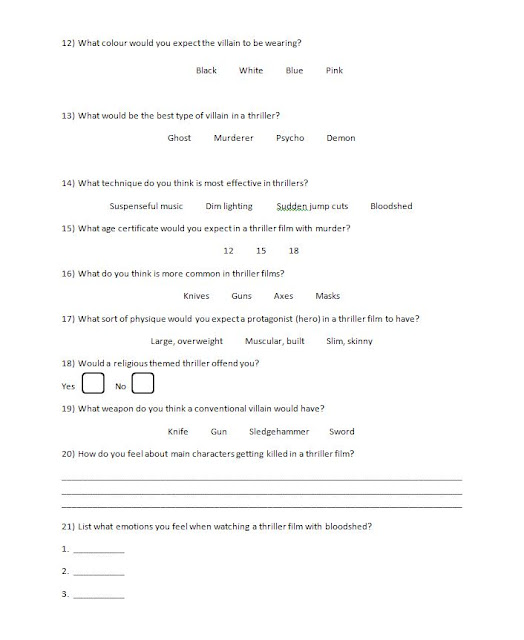
I carried out a questionnaire because I needed direct information, feedback and opinions from my potential target audience. The importance of my questionnaire is that it only gave me direct responses from my target audience, this was extremely useful as I could assess the answers to them and implement the necessary things to my thriller opening. Those answering the questions were given specific choices which also helped a lot, and different questions were given for initial ideas. As a group we then identified ideas and scrutinised each others questions, making sure our questionnaire was as useful to its full extent.
Key questions asked to help make key decisions
Some examples of the key questions we asked our audience
Multiple questions
What kind of character would you want a thriller film to be centered around?

Results of key graphs
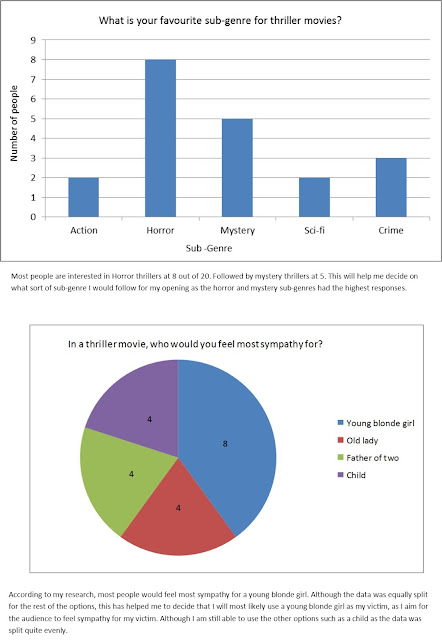
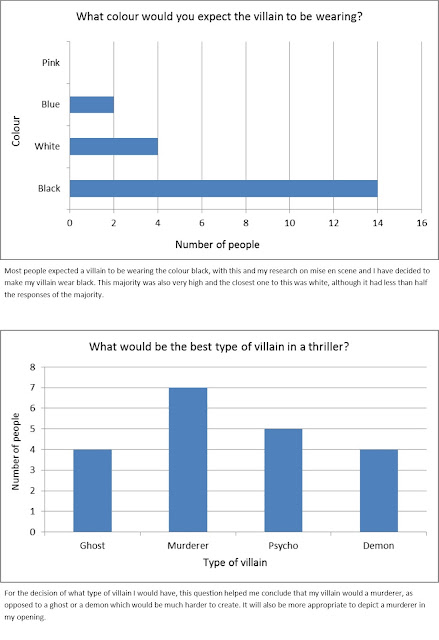
Overall the primary research was important because the questionnaire was the only part of our research that we were directly involved in and could get direct feedback and opinions from a potential target audience. It helped me address my target audience as I could apply their feedback to my thriller to make it appealing to my target audience, as the questionnaire was given to the age range of the people we considered to be the target audience for our thriller.
Audience feedback
After creating a rough cut of my thriller opening,a focus group was held to get the direct opinions and feedback from an audience which mostly consisted of AS and A2 Media, drama and Film studies students. This would be a lot more useful as their feedback would be a lot more technical and accurate to minor flaws in my thriller opening. below is some of the constructive criticism I received.
Focus group images


Positive feedback from Sophie, aged 18
After receiving this feedback I felt as if I had attracted my audience properly through the use of mise en scene to build character representation.
Positive feedback from Laura, aged 16
This feedback made me feel glad that I used the sound effectively during the editing process.
I also received negative feedback from Sally, aged 15
This feedback made me understand that I had to alter the typography slightly by making it bolder and therefore clearer to read.
Finally I also received a form of negative feedback from Amanda, aged 17
This criticism made me realise that we should have taken into consideration the antagonist's clothing before filming so he could have had a more intimidating affect on the audience.
Secondary research into existing films is very important when it came to the idea of target audiences and choosing one. Doing this research allowed me to understand the demographics of people who watch thriller films and what appealed to which audiences. This is vital as many key decisions had to be made in terms of mise en scene, conventions, characters and themes. Analysing audience responses properly and understanding what different people want in thrillers helped us make these decisions and to make the appropriate decisions.
The target audience of thriller films:
With my secondary research into thrillers, I believe that the target audience that they appeal to are generally of the following:
Age: 15-40
Gender: Unisex
Ethnicity: No specific ethnicity. Universal appeal.
Occupation: Students, usually in higher education and people in employment.
Hobbies and interests: Sports, reading, playing video games and going to the cinema to watch films regularly.
I believe that from thriller films the target audience enjoy the thrill and excitement when watching thriller films. I had learned that violence and murder seemed to appeal to the younger generation more as they were more interested in themes such as death. The target audience seemed to also enjoy watching horror thriller films as they enjoyed the feeling of being scared and the emotions it makes them feel.
Furthermore, the emotions I believe the audience are likely to experience are both psychological and physiological. When are there scenes in thriller films that involve the protagonists or antagonists, they can evoke emotions such as fear or happiness, depending on the character and what they are doing. For example if the protagonist is in trouble and something bad is about to happen to them, the audience may experience the psychological emotions of fear, sadness or anxiety. But they will also experience the physiological effects of sweating and an elevated heartbeat. This can also happen when seeing dead bodies or an antagonist attempting or going through with murder. Another feature I found in thriller films which was very effective in evoking emotions was jump scares. If there is a scene where a figure would appear suddenly and unexpectedly, the audience would enjoy this as they find the appeal in being frightened and the rapid elevating of their heartbeat due to excitement.
This was useful research as it meant that for my thriller I had to consider what conventions and themes to follow to appeal to my target audience. Also I had to follow the BBFC guidelines to make sure there was not too much violence, or blood to make it more than a 15 rated film, my secondary research into the BBFC aided this greatly. I had to consider the genre and whether it attracted the audience I wanted of young adults aged 15 and above, who enjoy going to the cinema regularly and watching thriller films.
I carried out a questionnaire because I needed direct information, feedback and opinions from my potential target audience. The importance of my questionnaire is that it only gave me direct responses from my target audience, this was extremely useful as I could assess the answers to them and implement the necessary things to my thriller opening. Those answering the questions were given specific choices which also helped a lot, and different questions were given for initial ideas. As a group we then identified ideas and scrutinised each others questions, making sure our questionnaire was as useful to its full extent.
Key questions asked to help make key decisions
Some examples of the key questions we asked our audience
Multiple questions
What kind of character would you want a thriller film to be centered around?
Victim Murderer Anti-Hero Detective Hero
What technique do you
think is most effective in thrillers?
Suspenseful
music Dim lighting Sudden jump cuts Bloodshed
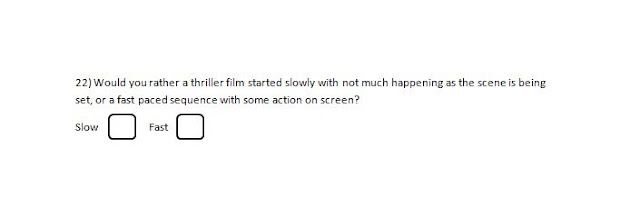
Open ended
How do you feel about main
characters getting killed in a thriller film?
What excites you most
about a thriller film and why?
These questions were very specific to my thriller idea and helped make the final decisions as the audience feedback and influence was vital for audience appeal.
Quotes of answers from our open ended questions and how it helped make key decisions
How do you feel about main characters getting killed in a thriller film?
"This would be very effective in a thriller film as it is a very unexpected thing to happen. It would scare the audience as well as confuse them as it is not conventional for the main character to die in a film." - Shane, aged 17
What excites you most about a thriller film and why?
"The suspense and usually violence is what excites me most in a thriller film. Probably because of the physiological effect a thriller film has on me and that violence isn't very common for me so it's exciting" - Alice, aged 21
These questions helped me make key decisions such has presenting the apparent death of a main character as the girl that follows the antagonist. This was because I was sure I could appeal to the audience due to the results from my questionnaire and therefore had to make the key decision in the narrative of my opening. As well as this the other open ended question helped us make the decisions to add elements of suspense and violence to excite the audience.
Results of key graphs
Overall the primary research was important because the questionnaire was the only part of our research that we were directly involved in and could get direct feedback and opinions from a potential target audience. It helped me address my target audience as I could apply their feedback to my thriller to make it appealing to my target audience, as the questionnaire was given to the age range of the people we considered to be the target audience for our thriller.
Audience feedback
After creating a rough cut of my thriller opening,a focus group was held to get the direct opinions and feedback from an audience which mostly consisted of AS and A2 Media, drama and Film studies students. This would be a lot more useful as their feedback would be a lot more technical and accurate to minor flaws in my thriller opening. below is some of the constructive criticism I received.
Focus group images


Positive feedback from Sophie, aged 18
After receiving this feedback I felt as if I had attracted my audience properly through the use of mise en scene to build character representation.
Positive feedback from Laura, aged 16
This feedback made me feel glad that I used the sound effectively during the editing process.
I also received negative feedback from Sally, aged 15
This feedback made me understand that I had to alter the typography slightly by making it bolder and therefore clearer to read.
Finally I also received a form of negative feedback from Amanda, aged 17
This criticism made me realise that we should have taken into consideration the antagonist's clothing before filming so he could have had a more intimidating affect on the audience.
Wednesday, 3 February 2016
Tuesday, 2 February 2016
Tuesday, 26 January 2016
Monday, 18 January 2016
Evaluation: Question 4 - Who would be the audience for your media product? - Miss Begum
Question 4) Who would be the audience for your media product?
Monday, 14 December 2015
Planning: Storyboard - Miss Begum
Storyboard
Introduction
A storyboard is a sequence of drawings, typically with directions and dialogue which represents the shots planned for a film production. The storyboard I used had information on camera shots, location, props, lighting, actors, sound, dialogue, editing and a narrative description. It helps the director understand what to film and how to film the scenes. Also it guides them to make decisions on what sequences to film first. It makes the biggest part, the filming process, much easier and more efficient as making a film requires a lot of time and effort.
Advantages of a storyboard
- Saves time for directors and editors when filmmaking
- Gives directors clear indications on how to film sequences
- To get a clear picture of the visual that is being made
- Helps the crew and cast with what they are doing
- Informs the crew on what equipment and props are needed
Disadvantages of a storyboard
- There may be problems if the storyboard isn't followed or accurate
- It takes a lot of production time to construct a storyboard
- May not be able to follow the storyboard due to lack of resources on set
My storyboard


Conclusion
In conclusion, my storyboard will be useful when it comes to filming the opening, therefore it is essential for planning. I will be able to shoot quicker and organise props and actors much more efficiently if I get into the habit of constantly referring to my storyboard. I also have an idea of the sound I am going to use and this will help me in the post-production process. Without my storyboard it is highly likely that my production and filming would take much longer and may not even make sense as I would only have my narrative to follow when filming, this would not have been anywhere near as efficient. The storyboard, along with the group roles will be extremely beneficial as the crew and cast will know what they are doing at all times and therefore the production will be a lot more time efficient.
Friday, 11 December 2015
Planning: Planning Cinematography, Sound and Editing - Mrs. Quinlan
Micro-elements
Introduction:
Micro elements in film are some of the most important aspects of film making when it comes to the application of them. The three main elements are cinematography, sound and editing. Cinematography is the general term used for camera angles, shots and movements. Cinematography is one of the most important aspects when it comes to all films and especially thrillers, this is because it can really define the character representation and the tone of the film. For example, if there is an antagonist shown on screen, which is typical for a thriller film, there will be a use of a low angle shot to show that the antagonist is above as this asserts dominance. This can also instil fear amongst the audience as a low angle shot is used in darkness, usually where you cannot see the antagonists face. Sound is also vital to a thriller film as sound can create tension for the audience or manipulate the audiences' mood in general. An example of this is off screen sound of traffic or people speaking, this can create an environment for the audience as it lets the audience know there are other people around or the place is busy, this is shown without having extras or props visible. Editing is another paramount micro element. Editing is a post production process which puts all the raw footage together to create a sequence, this is very important as the film would not flow as well if there was no editing. Editing can also consist of filters or effects such as slow motion editing which can help put emphasis on a character or an event on screen.
Cinematography
1) Establishing Shot - We decided that the first movement in our thriller opening will be an establishing shot which will be used for the audience to understand where the antagonist has come from according to the type of costume he's wearing. The establishing shot/ extreme long shot will show the audience the antagonist from head to toe followed by the background from behind so its clear when the viewers are watching. This will make the audience question themselves who's funeral is this and why doesn't the character look upset.
 2) Medium Shot - We decided to use medium shots as they are very simple to portray what is happening in the current scene. A medium shot is simple to do and is a type of cinematography that can transition one scene to another without the audience getting too confused or distracted of what happened. We want to use these medium shots so the audience are able to see the characters more clearly where their costume, hair and make-up is clearly visible.
 3) Close-up - We've also planning on using many close-up shots to make sure that what were trying to the audience is clearer enough, to do this, we can use the clos-up shot. When our antagonist is walking up the stairs, we want a close-up of his feet walking up the stairs. When this technique is used, the audience are also able to see the hands of dead bodies on the floor when the camera closes up to his feet. This is to create more tension for the audience asking them feel uneasy and scared for what has to come after.
 4) Long Shot - We also planning on using long shots in our thriller opening to demonstrate the ghostly and creepy figure that appears when the antagonist turns off the light in his bedroom. The long shot is appropriate for this scene because the viewers can see the figure clearly from head to toe but still are not able to work out who this mystery person is. This creates a chilling response from the audience which is also accompanied by the back lighting.
 5) High Angle - We decided that we also wanted to use a high angle shot for when the antagonist walks down the stairs in frame 11. This is when the audience are able to witness the dead bodies on the staircase that they were able to see before. This is to confirm that the antagonist is a psychopath killer just in case some viewers didn't quite catch on what type of character he is. This creates a shock reaction from the audience because its a quite abrupt way to demonstrate what type of character he is.
 6) Tilt Shot - A tilt shot we also be used in our thriller opening. This is when the audience the first clue of this psychopath killer. When he arrives home, everything seems very normal till the camera tilts towards the floor where he picks up a piece of furniture from the floor covered in blood followed by some dead bodies lying around the floor, lifeless.
7) Low Angle Shot - A low angle shot we decided to use when the antagonist walks up the stairs towards his bedroom to get change. This low angle makes him look like the dominant and superior one further making him look powerful and strong as well. The audience will feel uneasy and quite intimidated by this frame and the low angle does make him look physically bigger.
1) Diegetic Sound - We plan on using non-diegetic sound in our thriller which is just sound from the film world like the rain hitting his window of his house. This will create the tense and gloomy atmosphere better which will make the audience feel uneasy and quite scared
 2) Parallel Sound - Parallel sound is when the sound you hear in a film is expected for example, we want to use parallel sound when he does simple stuff around the house and when his outside of this house. When he leaves the funeral, we hear the rain which is expected as we see it clearly in this scene. When the antagonist arrives home, we expect to hear the door slam when he shuts it on the mystery girls face.
 3) Contrapuntal Sound - When we are able to see the bodies scattered around the house, we decided to use contrapuntal sound in this scene with a soundtrack that doesn't quite fit with the scene as this creates a better response from the audience, no only they're afraid but confused on why these bodies are here. There will be a soundtrack that doesn't quite fit such as classical music playing in the background whilst he goes to leave his house. This will create an even bigger and noticeable contrast between the sound and what is going on which makes the audience question this mystery character even more.
 4) On-screen Sound - The on-screen sound is quite similar to diegetic sound, I want the audience to able also hear the on-screen sound that they are also able to see for example when the antagonist closes the door and leaves the house we can hear the rain and wind and the muffled chatter of other people on the street.
 5) Non-diegetic Sound - We also decided that we wanted non-diegetic sound used in our thriller opening. The non-diegetic sound which is not part of the film world. We plan on using diegetic sound when we begin to edit our thriller. When the anti-hero appears, we plan on using the diegetic sound of a sound track to create more tension for the audience which will create a more chilling experience. This further creates suspense and shock for the audience as this was unexpected, moreover, this is the first appearance the anti-hero makes which the audience are introduced to which makes them even more uneasy.
Editing:
One of the editing techniques we will be using is slow motion editing. This will be at the very beginning of the opening as the antagonist is walking from the graveyard. We will use this to put emphasis on the antagonist and his movements, as well as the environment around him, this is to show the audience where the antagonist is. Although they do not know who he is at this moment in time, it will create confusion amongst the audience as they will question who he is and what he is doing in a graveyard during the slow motion sequence.
Another editing technique we will be using are straight cuts, these are simple cuts that will be applied throughout the opening to show a change in the shot or to show the next shot. For example a straight cut would be from the graveyard to the inside of a house where the door is visible, and the antagonist will then walk in. We will not see his opening the door or see how he enters the premises, the straight cut will help with that.
We will also be using jump cuts, this is in combination with the slow motion editing as the antagonist is walking away from the graveyard, this is to speed up his movement but not so fast that the audience aren't able to see the environment he is in.
Other editing techniques would be transitions so that the change from the titles and production logos to the opening itself is very smooth and does not look out of place with the tone or pace of the opening.
Filters will also be used when appropriate to convey a darker tone, for example when the antagonist is walking through the graveyard which is conventionally a gloomy and desolate environment there would be a grayscale filter.
In conclusion, I have decided that in terms of cinematography I will vary the shots as much as possible to keep the audience very interested, this is so the shots do not get repetitive and the audience are constantly intrigued. When appropriate the shots will be used such as high angle shots, establishing shots, medium and long shots. Non diegetic and on screen sound will be the most significant sound techniques I will use as the soundtrack, the sound effects and the sound showing the characters movements will be very important in creating the audiences' reaction. The soundtrack is vital as it will set the overall pace and tone of the opening, while the on screen sound will give the opening some life such as footsteps or doors being shut. When editing, similarly to cinematography I will use as many techniques as I can where appropriate to keep the audience interested.
Introduction:
Micro elements in film are some of the most important aspects of film making when it comes to the application of them. The three main elements are cinematography, sound and editing. Cinematography is the general term used for camera angles, shots and movements. Cinematography is one of the most important aspects when it comes to all films and especially thrillers, this is because it can really define the character representation and the tone of the film. For example, if there is an antagonist shown on screen, which is typical for a thriller film, there will be a use of a low angle shot to show that the antagonist is above as this asserts dominance. This can also instil fear amongst the audience as a low angle shot is used in darkness, usually where you cannot see the antagonists face. Sound is also vital to a thriller film as sound can create tension for the audience or manipulate the audiences' mood in general. An example of this is off screen sound of traffic or people speaking, this can create an environment for the audience as it lets the audience know there are other people around or the place is busy, this is shown without having extras or props visible. Editing is another paramount micro element. Editing is a post production process which puts all the raw footage together to create a sequence, this is very important as the film would not flow as well if there was no editing. Editing can also consist of filters or effects such as slow motion editing which can help put emphasis on a character or an event on screen.
Cinematography
1) Establishing Shot - We decided that the first movement in our thriller opening will be an establishing shot which will be used for the audience to understand where the antagonist has come from according to the type of costume he's wearing. The establishing shot/ extreme long shot will show the audience the antagonist from head to toe followed by the background from behind so its clear when the viewers are watching. This will make the audience question themselves who's funeral is this and why doesn't the character look upset.
 2) Medium Shot - We decided to use medium shots as they are very simple to portray what is happening in the current scene. A medium shot is simple to do and is a type of cinematography that can transition one scene to another without the audience getting too confused or distracted of what happened. We want to use these medium shots so the audience are able to see the characters more clearly where their costume, hair and make-up is clearly visible.
  3) Close-up - We've also planning on using many close-up shots to make sure that what were trying to the audience is clearer enough, to do this, we can use the clos-up shot. When our antagonist is walking up the stairs, we want a close-up of his feet walking up the stairs. When this technique is used, the audience are also able to see the hands of dead bodies on the floor when the camera closes up to his feet. This is to create more tension for the audience asking them feel uneasy and scared for what has to come after.
 5) High Angle - We decided that we also wanted to use a high angle shot for when the antagonist walks down the stairs in frame 11. This is when the audience are able to witness the dead bodies on the staircase that they were able to see before. This is to confirm that the antagonist is a psychopath killer just in case some viewers didn't quite catch on what type of character he is. This creates a shock reaction from the audience because its a quite abrupt way to demonstrate what type of character he is.
 6) Tilt Shot - A tilt shot we also be used in our thriller opening. This is when the audience the first clue of this psychopath killer. When he arrives home, everything seems very normal till the camera tilts towards the floor where he picks up a piece of furniture from the floor covered in blood followed by some dead bodies lying around the floor, lifeless.
7) Low Angle Shot - A low angle shot we decided to use when the antagonist walks up the stairs towards his bedroom to get change. This low angle makes him look like the dominant and superior one further making him look powerful and strong as well. The audience will feel uneasy and quite intimidated by this frame and the low angle does make him look physically bigger.
The following sounds we intend to use:

1) Diegetic Sound - We plan on using non-diegetic sound in our thriller which is just sound from the film world like the rain hitting his window of his house. This will create the tense and gloomy atmosphere better which will make the audience feel uneasy and quite scared

 3) Contrapuntal Sound - When we are able to see the bodies scattered around the house, we decided to use contrapuntal sound in this scene with a soundtrack that doesn't quite fit with the scene as this creates a better response from the audience, no only they're afraid but confused on why these bodies are here. There will be a soundtrack that doesn't quite fit such as classical music playing in the background whilst he goes to leave his house. This will create an even bigger and noticeable contrast between the sound and what is going on which makes the audience question this mystery character even more.
 4) On-screen Sound - The on-screen sound is quite similar to diegetic sound, I want the audience to able also hear the on-screen sound that they are also able to see for example when the antagonist closes the door and leaves the house we can hear the rain and wind and the muffled chatter of other people on the street.
 5) Non-diegetic Sound - We also decided that we wanted non-diegetic sound used in our thriller opening. The non-diegetic sound which is not part of the film world. We plan on using diegetic sound when we begin to edit our thriller. When the anti-hero appears, we plan on using the diegetic sound of a sound track to create more tension for the audience which will create a more chilling experience. This further creates suspense and shock for the audience as this was unexpected, moreover, this is the first appearance the anti-hero makes which the audience are introduced to which makes them even more uneasy.
Editing:
One of the editing techniques we will be using is slow motion editing. This will be at the very beginning of the opening as the antagonist is walking from the graveyard. We will use this to put emphasis on the antagonist and his movements, as well as the environment around him, this is to show the audience where the antagonist is. Although they do not know who he is at this moment in time, it will create confusion amongst the audience as they will question who he is and what he is doing in a graveyard during the slow motion sequence.
Another editing technique we will be using are straight cuts, these are simple cuts that will be applied throughout the opening to show a change in the shot or to show the next shot. For example a straight cut would be from the graveyard to the inside of a house where the door is visible, and the antagonist will then walk in. We will not see his opening the door or see how he enters the premises, the straight cut will help with that.
We will also be using jump cuts, this is in combination with the slow motion editing as the antagonist is walking away from the graveyard, this is to speed up his movement but not so fast that the audience aren't able to see the environment he is in.
Other editing techniques would be transitions so that the change from the titles and production logos to the opening itself is very smooth and does not look out of place with the tone or pace of the opening.
Filters will also be used when appropriate to convey a darker tone, for example when the antagonist is walking through the graveyard which is conventionally a gloomy and desolate environment there would be a grayscale filter.
In conclusion, I have decided that in terms of cinematography I will vary the shots as much as possible to keep the audience very interested, this is so the shots do not get repetitive and the audience are constantly intrigued. When appropriate the shots will be used such as high angle shots, establishing shots, medium and long shots. Non diegetic and on screen sound will be the most significant sound techniques I will use as the soundtrack, the sound effects and the sound showing the characters movements will be very important in creating the audiences' reaction. The soundtrack is vital as it will set the overall pace and tone of the opening, while the on screen sound will give the opening some life such as footsteps or doors being shut. When editing, similarly to cinematography I will use as many techniques as I can where appropriate to keep the audience interested.
Wednesday, 9 December 2015
Planning: Shot List - Miss Begum
Shot list
Intro:A shot list is a document which consists of information on every single shot that will be taken during a film. In our thriller opening shot list there were the number of shots, the shot size/angle, the camera movement and other notes. Once our shot list was completed it consisted of 25 shots, although this may very during filming depending on many factors such as whether we will be able to get the particular shot properly due to lighting, or whether our movement is restricted when filming.
Example of shot list:


The shot list is very useful as it will greatly assist the director, camera operator and other crew members on set. The shot list will help during filming as it will speed up the process, after one scene is shot a quick look at the shot list will make it clear to the film crew as to what to film next and what equipment they need. The additional notes help as it helps the director visualise the shot while he is on set. This will assist the camera operator and eventually the editor in the post production process.
Planning: Mise En Scene - Mrs. Quinlan
Introduction:
Mise en scene is made up of body language, facial expression, lighting, setting, costume, hair and makeup and iconography. Mise en scene is vital in film, especially in thriller films. Mise en scene can make the audience feel differently depending on how the director or editor wants the particular scene or shot to come across. Mise en scene can also contribute to how the audience understand the scene, for example body language and facial expressions can clearly tell the audience if a character is feeling negative and whether the events that are occurring should have positive connotations or negative connotations. Lighting can be low key or high key, low key lighting is generally for scenes that follow dark themes and negativity, high key lighting is for a more upbeat mood as you can see things clear. Setting is important as it gives the audience an idea of what is going to happen, some settings may connote different feelings or events. For example a cemetery is a dark setting which connotes death, and therefore will give the audience a sense of fear even if nothing has happened in terms of narrative.
 The lighting in my thriller opening will mainly consists of low-key lighting, supported by various angles such as high, low and back. This is to portray dark and gloomy events that will take place in this opening indicating that the antagonist is in fact, the antagonist. In the first scene when we see the antagonist leaving the cemetery after attending a funeral, the weather will be very cold and gloomy encouraging the idea of pathetic fallacy. The low-key lighting directed on this man shows that he is a dark character. When he arrives home, low-key lighting is used throughout to show this man who brings negative vibes where ever he goes to tell the audience that he is the protagonist.
When the Anti-hero appears, back lighting is used to only show her silhouette and creepy figure keeping her identity hidden makes the audience feel uneasy and scared.
Setting and Iconography:
There are 3 settings we will be using in our thriller, the first is a cemetery, the second is a house and the third is a high street or a public road.
We are using a cemetery for our opening as it will begin with the antagonist walking away from it. This will cause confusion for our audience as this is where the opening will begin and there will be many questions they can ask. The setting is great as it is quite typical for a thriller film as this is where the dead rest, it is unconventional for someone to be their on their own and the connotations of a cemetery are intended to frighten the audience. An example of this are the large trees and the the greenery which usually represent nature or the outdoors, but there will be a lot of gravestones which will indicate that the antagonist was there when it is empty, this will indicate a sense of wrong doing.

The next setting we will use is a house. There will be a few dead bodies scattered around the house which will immediately confuse and frighten the audience. The antagonist walks around the house ina very casual manner and this is very unconventional as a home is meant to connote a place of safety and happiness, therefore it will bring the audience a lot of fear as being in the safety of your own home is what most people can relate to. A house with dead bodies goes far against the norm and will make the audience very uncomfortable.

The last setting we will use is a public road as the antagonist will walk down a public road as he leaves his house. This will be very unconventional as a public road is where many people will be. After the audience observes the dead bodies in the house, they will see that the antagonist is free and can go wherever he wants, this will particularly scare the audience as this shows that the antagonist could be anyone and could act as anyone.

There will not be much iconography used, there will only be blood on the dead bodies to show that they have been killed and a jacket that the antagonist changes into when he arrives home. There will also be a phone that the antagonist collects off the bed as he is leaving the room, this will serve as a distraction for when the anti hero suddenly appears behind him.
The now Anti-hero is wearing all white long dress to show that that she was once a victim of the antagonist. It further shows her once vulnerability and innocence that was taken away from her by the antagonist. She also wears large contact lens to empathise her dark eyes to show that she has evil intentions towards the antagonist. Long black hair to hide her identity for the audience to later discover. She has a pale face to show that she's dead, also with smudge make ran down her face to show that she has been crying in her past life.
All the victims would have similar clothing to show that they are the victims such as having light colours showing vulnerability. Preferably the colour white to show innocence and purity, furthermore when injured tends to contrast the colour red of blood making it stand out and more visible. Having colours like that contrasting is conventional for victims as it tells the audience almost immediately they've been hurt because they are the victim.
In conclusion, my character's body language and facial expressions will all be appropriate for the tone of the film, as well as the characters motives and goals. For example the antagonist having an upright posture with a neutral facial expression shows that he has a goal and he is confident. The settings we have chosen are very conventional to thrillers as graveyards connote death, and houses represent safety which is typically broken in thriller films. This will make them both very conventional and appropriate settings to use in our opening. The costume hair and makeup will also be conventional as the colour of the clothing will be the most significant thing. The victims will wear light coloured clothing as this represent innocence and a sense of normality while the antagonist and the anti hero will wear either black or white representing that they are neither in heaven or hell, but rather in between.
Mise en scene is made up of body language, facial expression, lighting, setting, costume, hair and makeup and iconography. Mise en scene is vital in film, especially in thriller films. Mise en scene can make the audience feel differently depending on how the director or editor wants the particular scene or shot to come across. Mise en scene can also contribute to how the audience understand the scene, for example body language and facial expressions can clearly tell the audience if a character is feeling negative and whether the events that are occurring should have positive connotations or negative connotations. Lighting can be low key or high key, low key lighting is generally for scenes that follow dark themes and negativity, high key lighting is for a more upbeat mood as you can see things clear. Setting is important as it gives the audience an idea of what is going to happen, some settings may connote different feelings or events. For example a cemetery is a dark setting which connotes death, and therefore will give the audience a sense of fear even if nothing has happened in terms of narrative.
Body Language & Facial Expression
Antagonist: Jamie Anderson
The Antagonist Jamie Anderson will have an upright posture with a neutral facial expression throughout the opening. Anderson has this body language because he is confident of who he is and he doesn't really seem vulnerable to get easily attacked. This portrays that he is an important character, audience might wonder if he's the protagonist or antagonist due to his confident and upright body language he'll have in the opening. Anderson has a neutral facial expression throughout which doesn't indicate much yet till he gets home and remains calm when he after the viewers witness dead bodies scattered around his house. He has no reaction towards these dead bodies and simply ignores them like there's nothing there, this could indicate that his the antagonist as audiences are able to clearly infer that these people in his house were killed by him. Further suggesting that the antagonist is a psycho killer because a normal person wouldn't react to this normally. This is conventional to a thriller film because the audience are able to understand clearly that he is psycho through his neutral expression.Anti-Hero/ Victim: Trang Lam
The anti-hero/ victim also has a slouched posture throughout the thriller opening to suggest that her body is lifeless. She's un-dead which is portrayed through her slouched and lifeless body that follows the antagonist around all day. This further portrays that she was a victim before but not longer shows that she's a victim by her neutral facial expression she has planted on her face which makes her the anti-hero, confident in what she's about to do next. Not only having a neutral expression to show that she's the anti-hero but also to denote that she's a living, dead body. She is a conventional thriller victim as her body language is slouched, showing vulnerability although at the same time, she is also an anti-hero because of her neutral expression instead of a scared expression to demonstrate that she's no longer a victim in the opening. Trang was once a victim, brutally murdered by the antagonist but has come back to seek vengeance and now is the anti-hero.Victims: Victim 1, 2, 3, 4
These victims will be scattered around the house, they will have no facial expression, with closed eyes, it tells the audience that they are simply lifeless bodies that have been killed by the antagonist. Body language is also something to indicate that they're dead, by having a resting position on the floor, not moving at all shows that they are dead. Victim 4 who appears in frame 9 is still alive but barely conscious. He has poor, slouched body posture to show that he is a vulnerable victim trapped within this prison by the antagonist. Victim 4 has a terrified facial expression to further portray that his an innocent victim when he sees his perpetrator.Lighting
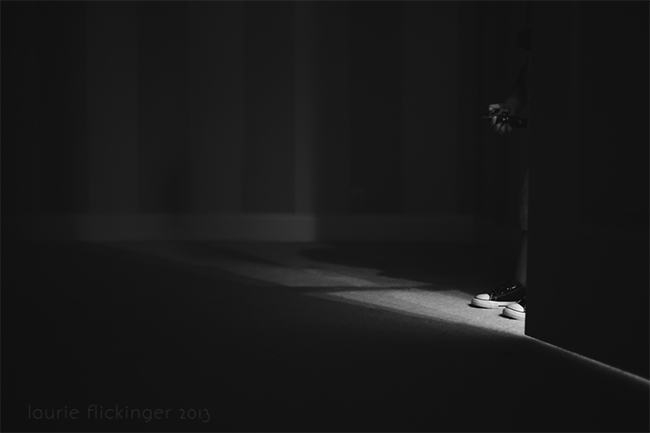 The lighting in my thriller opening will mainly consists of low-key lighting, supported by various angles such as high, low and back. This is to portray dark and gloomy events that will take place in this opening indicating that the antagonist is in fact, the antagonist. In the first scene when we see the antagonist leaving the cemetery after attending a funeral, the weather will be very cold and gloomy encouraging the idea of pathetic fallacy. The low-key lighting directed on this man shows that he is a dark character. When he arrives home, low-key lighting is used throughout to show this man who brings negative vibes where ever he goes to tell the audience that he is the protagonist.
 When the Anti-hero appears, back lighting is used to only show her silhouette and creepy figure keeping her identity hidden makes the audience feel uneasy and scared.
Setting and Iconography:
There are 3 settings we will be using in our thriller, the first is a cemetery, the second is a house and the third is a high street or a public road.
We are using a cemetery for our opening as it will begin with the antagonist walking away from it. This will cause confusion for our audience as this is where the opening will begin and there will be many questions they can ask. The setting is great as it is quite typical for a thriller film as this is where the dead rest, it is unconventional for someone to be their on their own and the connotations of a cemetery are intended to frighten the audience. An example of this are the large trees and the the greenery which usually represent nature or the outdoors, but there will be a lot of gravestones which will indicate that the antagonist was there when it is empty, this will indicate a sense of wrong doing.


The next setting we will use is a house. There will be a few dead bodies scattered around the house which will immediately confuse and frighten the audience. The antagonist walks around the house ina very casual manner and this is very unconventional as a home is meant to connote a place of safety and happiness, therefore it will bring the audience a lot of fear as being in the safety of your own home is what most people can relate to. A house with dead bodies goes far against the norm and will make the audience very uncomfortable.

The last setting we will use is a public road as the antagonist will walk down a public road as he leaves his house. This will be very unconventional as a public road is where many people will be. After the audience observes the dead bodies in the house, they will see that the antagonist is free and can go wherever he wants, this will particularly scare the audience as this shows that the antagonist could be anyone and could act as anyone.

There will not be much iconography used, there will only be blood on the dead bodies to show that they have been killed and a jacket that the antagonist changes into when he arrives home. There will also be a phone that the antagonist collects off the bed as he is leaving the room, this will serve as a distraction for when the anti hero suddenly appears behind him.
Costume, hair and make-up
The Antagonist: Jamie Anderson The Anti-Hero/ Victim: Trang Lam
 Victims: 1, 2, 3

Anderson will be dressed in black suit. This shows that he is the antagonist who knows well what he's doing. This is because the dark colour black portray his dark and evil intentions but the suit generally indicates that his confident in what he does. He is the antagonist that is the psycho killer who clearly gets away with it. He later changes into all dark clothes to make the audience fully understand clearly that he is the antagonist. He is neatly groomed to blend within society further demonstrating that he looks like a normal person who will never be assumed of these terrible things.The Antagonist: Jamie Anderson
 The Anti-Hero/ Victim: Trang Lam
 Victims: 1, 2, 3
The now Anti-hero is wearing all white long dress to show that that she was once a victim of the antagonist. It further shows her once vulnerability and innocence that was taken away from her by the antagonist. She also wears large contact lens to empathise her dark eyes to show that she has evil intentions towards the antagonist. Long black hair to hide her identity for the audience to later discover. She has a pale face to show that she's dead, also with smudge make ran down her face to show that she has been crying in her past life.
All the victims would have similar clothing to show that they are the victims such as having light colours showing vulnerability. Preferably the colour white to show innocence and purity, furthermore when injured tends to contrast the colour red of blood making it stand out and more visible. Having colours like that contrasting is conventional for victims as it tells the audience almost immediately they've been hurt because they are the victim.
In conclusion, my character's body language and facial expressions will all be appropriate for the tone of the film, as well as the characters motives and goals. For example the antagonist having an upright posture with a neutral facial expression shows that he has a goal and he is confident. The settings we have chosen are very conventional to thrillers as graveyards connote death, and houses represent safety which is typically broken in thriller films. This will make them both very conventional and appropriate settings to use in our opening. The costume hair and makeup will also be conventional as the colour of the clothing will be the most significant thing. The victims will wear light coloured clothing as this represent innocence and a sense of normality while the antagonist and the anti hero will wear either black or white representing that they are neither in heaven or hell, but rather in between.
Tuesday, 8 December 2015
Planning: Production Roles - Miss Begum
Production Roles
Introduction:
There are production roles that had to be filled for our final production, they had changed from the preliminary task as we have found who is suited to which role best. Each role has a different function and is vital to the final production and some roles are shared. The roles consist of a director, producers, camera operator, sound technician, editor, storyboard organiser, costume, hair and makeup organiser, lighting operator and location manager.
The roles:
Director - A director has to visualise the script or storyboard and then guides the crew and cast to create the film through the director's view. The director also chooses the cast and the production design and controls the the creative aspects of the film. It is important for the director to have good leadership skills and can give instructions clearly.
Producer - A producer supervises the production by selecting the location and the script. The producer also has the final say on sound and what scenes should be cut, also decides on distribution rights although this won't be relevant for our final production.
Camera operator - The camera operator, usually called a cinematographer. This person is responsible for maintaining the composition and camera angles when filming. This is to make the film look professional while following the directors instructions.
Sound technician - The sound technician assists in setting up, operating, and maintaining sound equipment. They also consult during the editing process when mixing or amplifying the sound.
Editor - The editor is involved in the post production process of filmmaking. They work with raw footage and selects shots and combines them to make a finished product. Editors generally work with the directors as they have the shots visualised and the editor has the skill to make this a final product. Editors need to have good organisational skills and be able to work under pressure.
Storyboard organiser - The storyboard organiser is charge of pre-visualising the motion picture. The storyboard will aide the director and editor greatly in the production and post production process. It is necessary for the storyboard organiser to have good organisational skills, as well as good time management skills.
Location manager - The location manager is responsible for finding and securing the location that will be used in the film. They will need to obtain all fire, police and governmental permits that are relevant to the film being made. They are also responsible for location scouting and work closely with the director and production designer as well as being responsible for public relations.
Costume, hair and makeup organiser - This is usually split into two different roles, a costume designer or supervisor and a makeup artist. The costume designer or supervisor is responsible for all the clothing and costumes that are worn by all the actors that appears on screen in a film. They are also responsible for designing, planning and organising the construction of the garments and their fabrics, colours and sizes. The make up artist is responsible for planning makeup designs for all leading and supporting cast. This includes, cosmetic makeup, body makeup and they will consult the special effects team if special effects are involved.
Lighting operator - Lighting operators or lighting technicians are responsible for the movement and set up of different pieces of lighting equipment for the separation of light. The lighting operator will also control whether there should be low key or high key lighting depending on which is more appropriate for the shot.
What are the group roles and why?
Director - We decided that I should be the director as I have good leadership skills and have a good sense of time management. This will be very important as during the filming process I will have to organise the cast and crew members, The actors will look at me for information on how they should look and behave on camera and the crew will want my input in their roles during filming. I will work closely with the story-boarder and the editors to make sure the opening is visualised correctly and put on screen correctly.
Producers - We decided that Trang should be the producer as she has excellent communication skills and this was evident during the preliminary task, she is a great problem solver and this will be very useful during filming as we may encounter problems with legality for example. This will be solved by her as she will hold onto the pre production paperwork as she had great input in it as the producer. She is also an excellent supervisor which is useful during editing as the producer should have great input during this.
There are production roles that had to be filled for our final production, they had changed from the preliminary task as we have found who is suited to which role best. Each role has a different function and is vital to the final production and some roles are shared. The roles consist of a director, producers, camera operator, sound technician, editor, storyboard organiser, costume, hair and makeup organiser, lighting operator and location manager.
The roles:
Director - A director has to visualise the script or storyboard and then guides the crew and cast to create the film through the director's view. The director also chooses the cast and the production design and controls the the creative aspects of the film. It is important for the director to have good leadership skills and can give instructions clearly.
Producer - A producer supervises the production by selecting the location and the script. The producer also has the final say on sound and what scenes should be cut, also decides on distribution rights although this won't be relevant for our final production.
Camera operator - The camera operator, usually called a cinematographer. This person is responsible for maintaining the composition and camera angles when filming. This is to make the film look professional while following the directors instructions.
Sound technician - The sound technician assists in setting up, operating, and maintaining sound equipment. They also consult during the editing process when mixing or amplifying the sound.
Editor - The editor is involved in the post production process of filmmaking. They work with raw footage and selects shots and combines them to make a finished product. Editors generally work with the directors as they have the shots visualised and the editor has the skill to make this a final product. Editors need to have good organisational skills and be able to work under pressure.
Storyboard organiser - The storyboard organiser is charge of pre-visualising the motion picture. The storyboard will aide the director and editor greatly in the production and post production process. It is necessary for the storyboard organiser to have good organisational skills, as well as good time management skills.
Location manager - The location manager is responsible for finding and securing the location that will be used in the film. They will need to obtain all fire, police and governmental permits that are relevant to the film being made. They are also responsible for location scouting and work closely with the director and production designer as well as being responsible for public relations.
Costume, hair and makeup organiser - This is usually split into two different roles, a costume designer or supervisor and a makeup artist. The costume designer or supervisor is responsible for all the clothing and costumes that are worn by all the actors that appears on screen in a film. They are also responsible for designing, planning and organising the construction of the garments and their fabrics, colours and sizes. The make up artist is responsible for planning makeup designs for all leading and supporting cast. This includes, cosmetic makeup, body makeup and they will consult the special effects team if special effects are involved.
Lighting operator - Lighting operators or lighting technicians are responsible for the movement and set up of different pieces of lighting equipment for the separation of light. The lighting operator will also control whether there should be low key or high key lighting depending on which is more appropriate for the shot.
What are the group roles and why?
Director - We decided that I should be the director as I have good leadership skills and have a good sense of time management. This will be very important as during the filming process I will have to organise the cast and crew members, The actors will look at me for information on how they should look and behave on camera and the crew will want my input in their roles during filming. I will work closely with the story-boarder and the editors to make sure the opening is visualised correctly and put on screen correctly.
Producers - We decided that Trang should be the producer as she has excellent communication skills and this was evident during the preliminary task, she is a great problem solver and this will be very useful during filming as we may encounter problems with legality for example. This will be solved by her as she will hold onto the pre production paperwork as she had great input in it as the producer. She is also an excellent supervisor which is useful during editing as the producer should have great input during this.
Camera operator- We decided that I should be the camera operator as this would be most efficient in such a small group, as I am the director, it will be much easier to give directions from behind the camera. I also have previous amateur experience with a camera and I am keen on learning more about camera operating. I immediately stepped forward to be the camera operator on the preliminary task and I wish to improve my film making skills through the opening.
Sound technician - We decided that I should be the sound technician as it will be more efficient as I will be on the computer during editing. I also have the necessary skills to work with the software we will be using when editing our thriller to add sound to it.
Sound technician - We decided that I should be the sound technician as it will be more efficient as I will be on the computer during editing. I also have the necessary skills to work with the software we will be using when editing our thriller to add sound to it.
Editor - We decided that I should also be the main editor as I develop knowledge quickly about software and have previous experience in amateur editing, I will use these skills and expand on them to make the opening into one of high standard. I am also confident and have good time management skills and therefore will edit efficiently.
Storyboard organiser - We decided that Trang should be the storyboard organiser as she is very good at drawing and is extremely artistic and creative, this will be useful as it will give a clear picture to the director on how I should film the shots and scenes. She is able to draw quickly and clearly and will be useful if we need to make any last minute changes.
Location manager - We decided that Trang should be the location manager as she is a very outgoing person and has a lot of knowledge on ideal locations for a thriller opening. She also has very good communication skills to request any permissions or supervise when doing so. She also has very strong organisational skills for when we are filming and therefore if we encounter a problem while filming on location she will be able to present the correct paperwork and solve any issues.
Costume, hair and makeup artist - We decided that Pervin should be the costume, hair and makeup artist as she is very creative and has the necessary skills to apply makeup for the cast. She is very artistic and will make the cast look very appropriate for the scene. For example if a victim needs to look dead she will apply the correct amount of blood or white makeup to make it look as if they have been killed or they have been dead for a certain amount of time. She will also choose the outfits appropriately.
Lighting operator - We decided that Pervin should be the lighting operator as she is very good at problem solving and is good at organisation. This will be very useful during the filming process as we may need a certain key of lighting and she will organise the area we are filming in to have that, she will also consult during editing to make the lighting appropriate for the scene.
Saturday, 5 December 2015
Planning: Pre-Production Paperwork - Miss Begum
Pre-Production Paperwork
Introduction:
Pre-production paperwork had to be produced before we started to film our thriller opening. We were legally obliged to do so and it will be very helpful during the filming process. The pre production paperwork consisted of a production schedule, camera shot list, location recce, location release form, risk assessment and client release form. These documents must have been completed as not only did it make filming more efficient, we needed the correct permissions to film in certain places and to prepare for and prevent any risks that may occur. The paperwork and copies of it had to be distributed amongst the cast, depending on whom it would benefit. The production schedule and location recce were given to the cast, as well as the client release form which had to be signed by each of them, the risk assessment was given to all crew members to help eliminate any risks. The director, producer and camera operator all held onto copies of the shot list to assist while filming. The forms were all produced by different crew members depending on who was more suited to which part of the paperwork.
Production Schedule:
The production schedule summarised what was going to happen during the filming process as well as when, who is involved, which scene is being shot and what equipment and props were being used. The production schedule would greatly benefit the cast and crew as they were all given a very clear idea of how the production would be made.

Location Recce:
Location recce contained information about where the filming will take place, directions on how to get there, why it is a good place to film and how it is relevant. This information will be distributed to and will be useful to all of the cast members so it will be easy for them to commute to the place where we are filming. Photos of the areas have also been included to assist.

The location release form is a legal document that discussed the terms and conditions for the people that have granted us permission to film in a particular location, this form will be given to the local authorities if asked for. Also can be given to the police if they believe we are filming on the wrong grounds. To further solidify our ability to film without any delays or problems, I contacted my local council on behalf of Jager Productions to request permission to film in the cemetery, as this could have been problematic if people did not agree with this or if it breached any legalities.


Client release form:
The client release form is a legal document stating the terms and conditions that may concern any cast member. It contains all information and legalities that concern the cast members and is signed by them to show that they are aware of the fact they will not be payed for this production and what is expected of them.


Risk Assessment:
The risk assessment is another legal document which needed to be filled in by the appropriate crew member and be distributed to all the crew members as they would be dealing with the risks. The assessment contains information on what risks could be there as well as how to deal with them. This document is important as it would speed up the filming process as well as help avoid risks which may damage production value.


Advantages of Pre-production paperwork:
- Pre production paperwork helps legitimise our production as it completes any legal documents that need to be and distributes them.
- Assists the cast and crew to complete the production quickly and efficiently as the production has a deadline.
- It analyses risks and how to confront them if they do occur, also helping with filming times.
- It organises the crew and cast well, as well as informs them on the locations where we will be filming.
- Problems and disagreements can be settled early due to the pre production paperwork which can also greatly help the production time and value.
Subscribe to:
Posts (Atom)